
WHAT IS COURT SHUFFLEBOARD?
Court shuffleboard is a game where a total of two, three or four players attempt to outscore their opponents by sliding (“shooting”) discs down a court (usually concrete) into the triangular scoring diagram painted at the opposite end. The discs which stay within the marked sections of this scoring diagram after all discs are shot count for scoring according to the point value of each section of the triangle: 10 at the tip, then 8’s below the 10, then 7’s below the 8’s, and finally minus-10 in the bottom section (called “10-off” or “kitchen”).
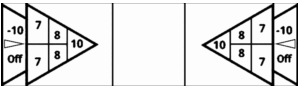
Shuffleboard is more than just a contest to see who can shoot more discs into scoring while knocking off their opponent’s scoring discs. It is very much a game of strategy, involving careful thought and accuracy to make the best shot each turn in order to advance your score or prevent your opponent’s advancement, on your way to victory.
Part of the charm of shuffleboard is that it can be played on equal footing by players of all ages, both male and female. Whole families can come to the courts together for quality time. It also can be successfully played by those with some physical infirmities. Anyone can participate and learn, getting out to the games for socializing, light physical exercise, and mental exercise as well.
Most importantly, shuffleboard is meant to be fun. There are many different game and tournament formats. Usually novice players meet at the courts for an hour or two to play some fun games. As players advance in their knowledge and skill, many begin to participate in more competitive games, leagues and tournaments. Eventually, any player with the desire can enter official tournaments to compete against other advanced players.
You will find other players are happy to see you succeed and willing to share their knowledge of the game with you. Your journey will be fun, challenging and rewarding, making many new friends along the way.
WELCOME TO THE SPORT OF SHUFFLEBOARD!
A SHORT HISTORY OF SHUFFLEBOARD
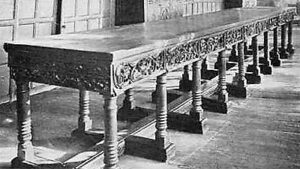
Shuffleboard developed centuries ago as an indoor game, sliding a large coin down a board, table or bar top as far as possible without falling off. The historical records of the game trace back to the 1400s in Great Britain. Originally the British groat (a coin of the time) was used, followed later by a silver penny, leading to the original names for the game: slide-groat, shovegroat, shove-penny and shovel-penny. The game came to be played as “shovelboard” by the British aristocracy, using metal weights instead of coins on highly decorated boards fashioned into long game tables. The shovel-penny version of the game became so popular that King Edward VIII outlawed it for commoners in the early 1500s, claiming the activity distracted his soldiers from their archery and combat training. This indoor table game spread throughout Europe as well as to the colonies in America, remaining popular through the centuries and evolving to modern table shuffleboard, played in bars and taverns as well as tournament competition worldwide.
In the 1840s, the game was brought aboard passenger cruise liners as a deck game, using wooden pronged sticks to slide wooden pucks down a board marked on the cruise deck, the first use of the moniker “shuffleboard” for the game. In 1913, an enterprising hotelier in Daytona Beach, Florida, brought shuffleboard to land by painting triangles for scoring on the sidewalk in front of his hotel and fashioning for his hotel guests the wooden sticks and discs. Soon hotels and resorts throughout Florida were painting their own outdoor courts. In 1915, the first concrete court was built at the Burgoyne Casino (a social hall, not a gambling venue) in Daytona Beach.
Outdoor court shuffleboard quickly spread, especially popular at resorts and retirement communities in Florida. The first two public courts were built in 1923 in St. Petersburg, Florida, leading to the formation of the St. Petersburg Mirror Lake Shuffleboard Club (later “St. Petersburg Shuffleboard Club”) and the first organized competitive games. The modern court design and rules of shuffleboard were defined in St. Petersburg and standardized throughout Florida with the formation of the Florida Shuffleboard Association in 1928, and later adopted throughout the country with the formation of the National Shuffleboard Association in 1931.
BASIC TERMINOLOGY
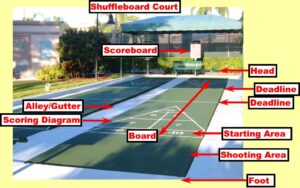
ALLEY: –The channel to either side of the court that runs parallel along the whole length of the court.
BASELINE: –The horizontal line forming the bottom of the scoring diagram, as well as the imaginary extension of this line through the alleys on either side.
BEADS, GLASS, SAND: –Fine glass globules, often coated in silicone, that are sprinkled on a court to reduce the friction between the bottom of the discs and the court surface.
BOARD: –The portion of a court where discs are played, including the scoring diagrams at the two ends and the area between.
CLEAR: –Shoot to knock discs off the board.
CLOSE DISC: -A disc that may be scoring but needs closer inspection to determine whether or not it is touching a line.
COURT: –The complete area for play of a game including the board, alleys, benches, scoreboards and shooting areas.
CUE DISC: –The disc that is currently being shot.
CUE STICK, CUE, STICK, TANG: -The pole with pronged ends (up to 6’3” in length) used to push the discs down the court.
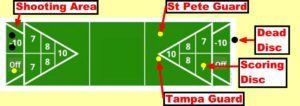
DEAD DISC: A disc that is out of or removed from play right after a shot because it didn’t reach the further deadline, passed beyond the further baseline or touched a gutter.
DEADLINE: -The two horizontal painted lines between the scoring diagrams of a court.
DISCS, BLOCKS, BISCUITS: –The 6” diameter colored circular pucks used to shoot and score. They are in two contrasting colors, most commonly black and yellow.
DOUBLES: –A game played with a partnered pair of players playing against another partner pair.
FOOT: –The end of the court opposite the scoreboard.
FRAME: –The portion of a game when all discs are shot by the two players at one end of the court and the game scores are updated and recorded on the scoreboard.
FUN GAME: -A game played for fun or practice, as opposed to tournament competition.
FRAME GAME: -A game played for a pre-determined number of frames, the highest score at the end of the last frame is the winner.
GUARD, COVER, HIDE, BLOCK: –A disc shot into a position to protect another disc on the board from the opponent.
GUTTER: –The portion of the alley that runs from baseline to baseline, usually sloping downward to the center.
HAMMER: –The last of the eight discs shot in a frame.
HEAD: –The end of the court with the scoreboard.
HIDE: –Shoot to put the cue disc in scoring and protected by a guard, or a disc that is in that position.
KITCHEN: –The 10-off area of the scoring diagram.
LIVE DISC: -A disc that remains in play after a shot.
OUT: –The player or disc color that shoots first in a frame.
ROUND-ROBIN: –A game played with three players, each keeping their own score to determine one winner.
POINTS GAME: -A game played until a pre-determined number of points is reached at the end of any frame, the highest score then the winner.
SCORING DIAGRAM, SCORING TRIANGLE: –The set of painted lines on the board that define the areas where discs earn points for scoring.
SEPARATION TRIANGLE: -The small painted triangle in the middle of the 10-off which separates the two sides, one for each color of discs when shooting.
SINGLES: –A game played one-on-one against an opponent.
SHOOTING AREA, STANDING AREA: -The portion of the court below the baseline where players stand while shooting.
STARTING AREA: –The 10-off area where the shooters place all their discs before the beginning of a frame.
ST PETE: –A guard placed on the opponent’s side of the board hallway between the tip of the scoring diagram and the edge of the court and about even with the tip.
TAMPA: -A guard placed on the shooter’s side of the board about even with and right next to the tip of the scoring diagram.
KEEPING SCORE – THE FUN GAME
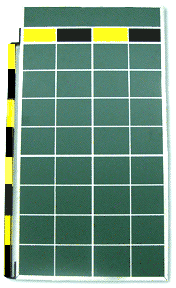
The player at the head that is closest to the scoreboard records the scores at the end of every frame. Most standard scoreboards have spaces to record sixteen frames, in a grid eight down and four across. If the scoreboard has a grid with ten down, cross out the bottom two rows of the grid for the 16-frame game.
Scores are recorded cumulatively down the scoreboard, adding the scores from any just-completed frame to the previous totals. Zeros are filled in on the scoreboard whenever a player’s cumulative score is zero (as commonly occurs near the beginning of a game). Negative numbers (a player’s score can go below zero when they end a frame with one or more discs in the kitchen) are recorded with a circle around the total score rather than a minus sign, for easier viewing from the far end of the court. Scores for the two colors are recorded in adjacent columns, yellow to the left, black to the right.
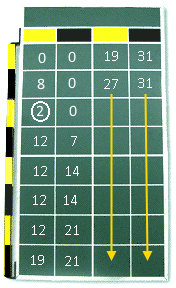
In walking singles, the scores are recorded going down the left half of the scoreboard for the first eight frames, until the two leftmost columns are filled. Then scoring continues down the right half for the next eight frames, until the two rightmost columns are also filled.
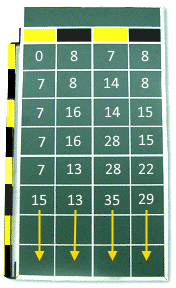
In non-walking singles, with four players on the court, two competing at the head and two competing at the foot, use the two leftmost columns for the scores of the players at the head and the two rightmost columns for the scores of the players at the foot. Once the first eight rows of the grid are filled after eight frames are played at each end, erase the top four rows to continue scoring the next frames. After the top two rows are filled again, erase the bottom four rows so that there are six blank rows to fill going all the way down the board for the final six frames of the 16-frame game.
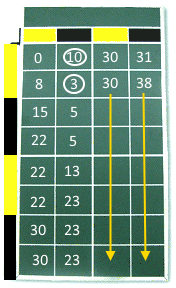
In doubles, the two leftmost columns are filled first for the first eight frames of the game, and then the two rightmost columns for the final eight frames of the game. Add the scores for the partner pairs cumulatively together on the scoreboard, scores for the two players playing yellow added to the yellow column and for the two players playing black added to the black column.
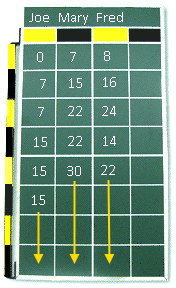
In a three-person round robin, the names of the players are written at the top of the scoreboard, one above each of the first three columns. For each frame, only the scores for the two players that shot the frame are recorded, adding each score to any prior cumulative score for each. Nothing is recorded for the third player that didn’t shoot the frame. If a player shot but didn’t score, their previous total (or zero if they haven’t scored any discs yet) is written again as their new total in the next row down. Following this procedure, every frame two scores are recorded and there is often a blank in a row for the third player that didn’t play a frame. For instance, after the first frame of the game, the two players that shot at the head will each have a recorded score in the first row of the scoreboard (a zero if they didn’t score any discs yet) and the third player will have a blank in the first row. That blank will be filled in after that player plays the next frame. Following this pattern, after every three frames all three players will
have the same number of rows filled in on the scoreboard. After all eight rows of the scoreboard are filled for the three columns of scores, erase the top half of the scoreboard (the first four rows). Continue recording scores at the top, adding to the scores that are in the bottom eighth row. Once you have filled the two top rows again, erase the bottom half of the scoreboard. Now you can continue scoring down the board until the bottom eighth row is filled again for all three columns, at which point you have reached the end of the game. For the full game, you have filled the three columns for scoring twice. The three players have played twenty-four frames in all, twelve at the head and twelve at the foot, but each player has played just sixteen frames out of the twenty-four, making this a 16-frame game.
A “round” is the complete set of all eight discs shot at both ends of the court, one frame at the head and then one frame at the foot. In some locales, the term “frame” is used in doubles instead of “round” to mean all eight discs shot at both ends. |
HOW TO SHOOT
The Grip
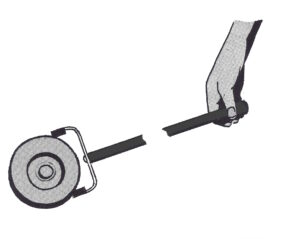
Hold the cue at the very end of the handle, lightly, the handle lying on two or three fingers which are lightly curled around, with your thumb resting on the top or the side of the cue to steady it. The other fingers are in their natural curled position back behind the end of the cue.
Starting Stance
First place the prongs of the cue stick against the cue disc. The prongs should stay against the disc, never pulled back, through the end of the shot. Next move your body to a position so your hand is right next to your hip when your arm and hand are dangling loosely and freely, no muscle tension, no added bend in your elbow or distancing of your arm from your body in any direction. Place your feet together or just slightly apart, where you have comfortable balance, standing straight up, neither foot forward of the other, your weight equal on both feet.
Aiming At Your Target
Face your whole body, including feet, torso and shoulders, straight at the exact direction you want to send the cue disc. As you adjust your body to the correct aim, keep your arm, hand and cue handle it its loose dangle position along the side of your body. Adjust the aim by shifting your whole body and the cue left or right, turning slightly as you go to fully face the spot on the court you want to aim. Every part of your body is relaxed – no knee bend, no elbow bend, no leaning, neither of your arms, hands, legs or feet in front of the other, your weight balanced on your feet, your hand and the cue handle next to your hip.
Delivery
Take two steps straight forward towards the direction you are aiming for delivery, first a small step (up to about half of a normal step) with your right foot and then a full step with your left foot (if you are left-handed, do the opposite feet).
During the small step with your right foot, your hand, the cue and the disc do not move forward from original position. At the end of the small step, your hand and arm will now be behind your hip, poised for its pendulum swing forward, your weight is fully on your right foot.
As your left foot hits the court during the second-full step, your hand and arm swing straight forward like a pendulum, with a smooth controlled motion. As the left foot becomes completely planted flat on the court, continue through with the swing of your arm to a full extension forward of the arm, hand and cue, eyes looking at your target, but do not raise the cue from the surface of the court. Your right foot will end with the toes still touching the court for balance, the rest of the foot flexed upward. Your left foot will end with the whole foot flat on the court, bearing your full weight. Your left knee will end slightly bent and your torso bent somewhat forward from the hips to allow full extension of the shooting arm. Keep your eyes on your target until the cue disc is well down the court.
Your steps should be smooth and steady, like you are walking through your shot – do not rush them. For delivery of the shot, the motion of your arm, hand and cue is a smooth pendulum swing, starting from the position behind your hip at the end of the small step with your right foot and ending at the full extension of your arm at the end of your full step with your left foot. Do not bend your elbow, twist your wrist or push your arm and hand left or right. The speed of the disc is not determined by the amount of muscle strength you use but rather the speed at which you make the pendulum swing. If you want the disc to go faster or further down the court, make a faster swing; if you want the disc to go slower or a shorter distance, make a slower swing.
If you prefer a one-step delivery due to comfort or physical restrictions, change your Starting Stance to be a small step forward of the normal starting stance. This brings your arm and hand to the same position behind your hip that they would be in after the first small-step of the two-step delivery. For the Delivery, take one full step with the left foot and follow the directions above as described for the second-full step of the two-step delivery. |